A Curated Life
Posted: June 25, 2015 Filed under: Misc., Technology 1 CommentIn last week’s post Less is More, I lightly referenced the problem of being bombarded with choices. Author Steve Rosenbaum, in a recent blog post, describes the challenge:
And yet — this abundance of connectivity has created a conundrum. It’s what author and psychologist Barry Schwartz calls the paradox of choice. Simply put — when we have too many options, too much input — we find ourselves overwhelmed with abundance. Young people called it FOMO, fear of missing out. And that fear leaves us often frozen in a blizzard of choice, unable to manage the volume of unfiltered input.
His solution? Living a curated life. Rosenbaum offers a five-pronged approach that is particularly useful in addressing the abundance of technology options and how to sift and winnow to a manageable number:
- Take a personal ‘rhythm’ inventory
- Right size your tools to your life
- Filter your friends
- Get offline and explore real world experiences
- You are what you Tweet and eat
The goal is to, “…not let devices or content drive how you live your life.”
Item two on the list gives me pause. I would hardly know where to begin itemizing all of the technology tools, websites, and apps that I touch every day. Rosenbaum suggests, “But if we’re going to curate our life, the first place to start is with our devices. Open your phone, look at each and every app you have — and delete 2/3’s of them.”

It’s so easy to be seduced by the many choices in the marketplace. Look at all of the choices we have as consumers. Interestingly, there are companies that are leveraging this idea of curation. Examples include: Canoe, Snow Peak, and Trunk Club.
What’s that saying about the first step toward recovery is admitting you have a problem? Yikes.
A Beautiful Mind
Posted: June 15, 2015 Filed under: Misc. | Tags: A Beautiful Mind, John Nash, Nash equilibrium, prisoner's delimma Leave a commentLast month, the national news headlines included a sad story of an elderly couple killed in a tragic accident on the New Jersey Turnpike. My family members, all avid moviegoers, recognized the husband as John Nash, the somewhat fictionalized subject of the move “A Beautiful Mind.”
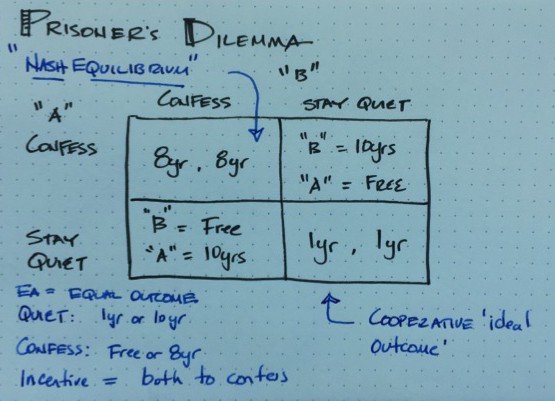
For me, his name brought back memories of economics and game theory coursework in graduate school. In particular, I recall the “Nash equilibrium,” an expansion of win/lose or zero-sum models. Nash also broadened the concept of multiple people maximizing the benefits when they act in their own self interest, which is known as the “prisoner’s dilemma.” Over the years, I have used this model and drawn dozens of matrices along these lines:
My daughters had a bit of Nash’s theories as part of their high school math coursework—they tend to have a bit of “math nerd” in them just like Mom and Dad. After the news story broke we had a lively and interesting discussion about Nash and his work. I think my daughters were impressed that, for once, I could actually discuss the subject of a movie. This led to the later exchange of articles written about John Nash’s life and work, including:
- The Bargaining Problem (1950 Princeton graduate school paper)
- The 2015 Abel Prize announcement (his last recognition)
- Abel Prize bio
Nash was a Nobel Prize winner, a unique feat given his long history with mental illness and absence from traditional academics and academic research. However, his key insights were just that impactful. R.I.P.
Currently Reading
Posted: June 1, 2015 Filed under: Business, Misc. | Tags: Becoming Steve Jobs, Search Inside Yourself, The Digital Doctor 2 CommentsIn an earlier post, I touched on my significant reading habit. Here are a couple of books that I am currently reading.

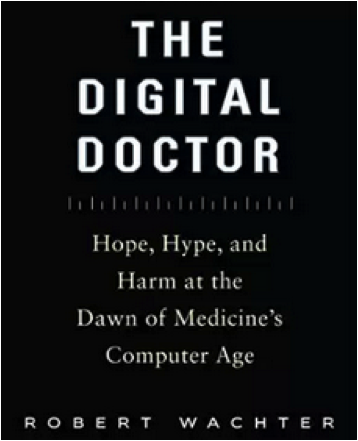

Becoming Steve Jobs: The Evolution of a Reckless Upstart into a Visionary Leader reveals the complex man behind the mythical figure. The movie version, starring Michael Fassbender, comes out this fall.
The Digital Doctor: Hope, Hype, and Harm at the Dawn of Medicine’s Computer Age takes a hard look at the impact of technology on healthcare delivery and patient care.
Search Inside Yourself: The Unexpected Path to Achieving Success, Happiness (and World Peace) is a self-help guide to implementing techniques from the practices of mindfulness and emotional intelligence. The goal is to improve quality of life, both inside and outside of the workplace.
 ZMAB15