A Curated Life
Posted: June 25, 2015 Filed under: Misc., Technology 1 CommentIn last week’s post Less is More, I lightly referenced the problem of being bombarded with choices. Author Steve Rosenbaum, in a recent blog post, describes the challenge:
And yet — this abundance of connectivity has created a conundrum. It’s what author and psychologist Barry Schwartz calls the paradox of choice. Simply put — when we have too many options, too much input — we find ourselves overwhelmed with abundance. Young people called it FOMO, fear of missing out. And that fear leaves us often frozen in a blizzard of choice, unable to manage the volume of unfiltered input.
His solution? Living a curated life. Rosenbaum offers a five-pronged approach that is particularly useful in addressing the abundance of technology options and how to sift and winnow to a manageable number:
- Take a personal ‘rhythm’ inventory
- Right size your tools to your life
- Filter your friends
- Get offline and explore real world experiences
- You are what you Tweet and eat
The goal is to, “…not let devices or content drive how you live your life.”
Item two on the list gives me pause. I would hardly know where to begin itemizing all of the technology tools, websites, and apps that I touch every day. Rosenbaum suggests, “But if we’re going to curate our life, the first place to start is with our devices. Open your phone, look at each and every app you have — and delete 2/3’s of them.”

It’s so easy to be seduced by the many choices in the marketplace. Look at all of the choices we have as consumers. Interestingly, there are companies that are leveraging this idea of curation. Examples include: Canoe, Snow Peak, and Trunk Club.
What’s that saying about the first step toward recovery is admitting you have a problem? Yikes.
Less is More
Posted: June 18, 2015 Filed under: Business, Change, Leadership | Tags: Essentialism, Greg McKeown 2 Comments Greg McKeown is the author of the acclaimed book Essentialism: The Disciplined Pursuit of Less. His website offers this description:
“The Way of the Essentialist isn’t about getting more done in less time. It’s not about getting less done. It’s about getting only the right things done. It’s about challenging the core assumption of ‘we can have it all’ and ‘I have to do everything’ and replacing it with the pursuit of ‘the right thing, in the right way, at the right time’. It’s about regaining control of our own choices about where to spend our time and energies instead of giving others implicit permission to choose for us.”
In an early 2015 Harvard Business Review article, McKeown argues that success is a catalyst for failure. The opportunities that we are bombarded with due to success causes us to lose the clarity that provided success in the first place.
His simple rules apply to both our personal and professional lives. To paraphrase:
- What am I absolutely passionate about? In the absence of passion, don’t waste time on what is simply average.
- What is absolutely essential? Once that is determined, eliminate the rest.
- Beware of the weight of “sunk costs.” Just because you own something, don’t feel you need to keep it. Just because you’ve always done something, that doesn’t sentence you to keep doing it indefinitely.
I’m sure there are things at both work and home where I am holding onto something that I’m not passionate about and/or is not essential. It must be valuable because why else would I hold onto it, right? Perhaps its time for a little soul searching and spring cleaning to purge some of the “more” to fully appreciate the value of “less.” The tough question is where to start?
A Beautiful Mind
Posted: June 15, 2015 Filed under: Misc. | Tags: A Beautiful Mind, John Nash, Nash equilibrium, prisoner's delimma Leave a commentLast month, the national news headlines included a sad story of an elderly couple killed in a tragic accident on the New Jersey Turnpike. My family members, all avid moviegoers, recognized the husband as John Nash, the somewhat fictionalized subject of the move “A Beautiful Mind.”
For me, his name brought back memories of economics and game theory coursework in graduate school. In particular, I recall the “Nash equilibrium,” an expansion of win/lose or zero-sum models. Nash also broadened the concept of multiple people maximizing the benefits when they act in their own self interest, which is known as the “prisoner’s dilemma.” Over the years, I have used this model and drawn dozens of matrices along these lines:
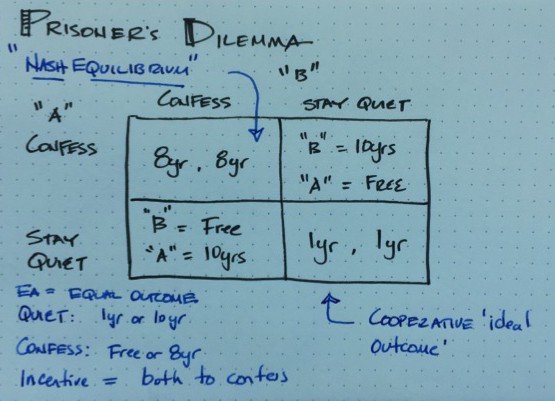
My daughters had a bit of Nash’s theories as part of their high school math coursework—they tend to have a bit of “math nerd” in them just like Mom and Dad. After the news story broke we had a lively and interesting discussion about Nash and his work. I think my daughters were impressed that, for once, I could actually discuss the subject of a movie. This led to the later exchange of articles written about John Nash’s life and work, including:
- The Bargaining Problem (1950 Princeton graduate school paper)
- The 2015 Abel Prize announcement (his last recognition)
- Abel Prize bio
Nash was a Nobel Prize winner, a unique feat given his long history with mental illness and absence from traditional academics and academic research. However, his key insights were just that impactful. R.I.P.
 ZMAB15