Mindfulness Meets Business
Posted: December 1, 2014 Filed under: Business, Misc. | Tags: 10% Happier, Dan Harris, Dr. Richard J. Davidson, Full Catastrophe Living, Jon Kabat-Zinn, MBSR, Mindful magazine, mindfulness, Time magazine Leave a comment“Mindfulness means paying attention in a particular way; on purpose, in the present moment, and non judgmentally.” —Jon Kabat-Zinn
Mindfulness has gone mainstream. Once only practiced by new age gurus and yogis, it is sweeping the nation, moving into gyms, homes and healthcare organizations at a rapid pace. Now it’s making the leap into corporate America, with Silicon Valley leading the charge (no surprise). Resources abound. If you’re as intrigued as I am, fire up your favorite search engine and query “mindfulness” or check out this handy list as a starting point.
Perhaps the seminal work on mindfulness is Full Catastrophe Living by Jon Kabat-Zinn. It has been recently revised and updated 25 years after first release. Kabat-Zinn also developed the Mindfulness-Based Stress Reductions program (MBSR), which has trained over 20,000 people in his techniques.

By Tiffany Vaché and Jason Sullivan
The Mind Full, or Mindful? wiki includes PowerPoint presentations, videos, websites, books and journals to facilitate a deep, varied dive into the subject.
10% Happier by Dan Harris hit #1 on the NYT Bestseller list earlier this year. The author, a noted television journalist, recounts his journey toward meditation and mindfulness following an on-air panic attack.
Colleges are getting on board. NYU’s New Mindfulness in Business Initiative is exploring how mindfulness can transform the next generation of leaders and innovators. One student describes her initial foray into meditation.
 Mindful magazine has a circulation of more than 85,000, with steep growth projected. Also in the periodical space, The Mindful Revolution was the cover story in a February 2014 issue of Time.
Otto Schamer, in Davos: Mindfulness, Hotspots, and Sleepwalkers, notes the rapid rise of mindfulness at the World Economic Forum in Davos, Switzerland this past spring. The drivers of this trend are described as new tech, new challenges and new science.
Dr. Richard J. Davidson at the Center for Investigating Healthy Minds is one leading scientific authority who is documenting the positive effects of mediation on the brain (here at UW Madison). A powerful documentary, Free the Mind, features his work with military veterans and school children.
For Your Edification
Posted: November 14, 2014 Filed under: Business, Innovation, Leadership | Tags: Jacob Morgan, Leaders Eat Last, Simon Sinek, Start with Why, The Future of Work, The Innovators, Walter Isaacson 1 CommentAs an avid reader, I usually have multiple books going at any one time. Here is a current sampling:


The Future of Work by Jacob Morgan
The Innovators by Walter Issacson. Did you know that one of the innovators behind the first computer studied at UW Madison? That “punch cards” were initially used for loom-based weaving? A low cost, infinite resource was a breakthrough for programming. Ada Lovelace, daughter of Lord Byron, wrote a series of notes in the 1840s that outlined the key concepts in the first electronic computer nearly 100 years before it was made in the 1940s? While parts of the book at too tedious for me, there are some very interesting facts that I never really appreciated.
Leaders Eat Last by Simon Sinek. I just started this one, but really enjoyed his previous Start with Why.
From Vertical to Horizontal – What?
Posted: October 28, 2014 Filed under: Business, Service, Technology | Tags: IT as a Service, ITaaS, touchpoints 3 CommentsThis is the second in a three-part series:
- From Vertical to Horizontal –Why?
- From Vertical to Horizontal –What?
- From Vertical to Horizontal –How? (coming soon)
The key to shifting to IT as a Service (ITaaS) is to orient your focus on the customer experience. Think of the example of going to a white tablecloth restaurant. What would a memorable dining experience feel like? What goes into providing an exceptional experience?
There are many touchpoints when the restaurant has an opportunity to create a favorable or unfavorable impression. They include the physical environment (parking, waiting area, bar, noise level, seating, lighting, view, etc.), everything related to the food (planning the menu, purchasing ingredients and preparation) and all matters staffing (hiring the right people, training and having the appropriate staffing level). All of the elements affect how you feel about the overall dining experience. Just because the food buyer found great tomatoes this week doesn’t ensure you’ll have a five-star Yelp rating experience.
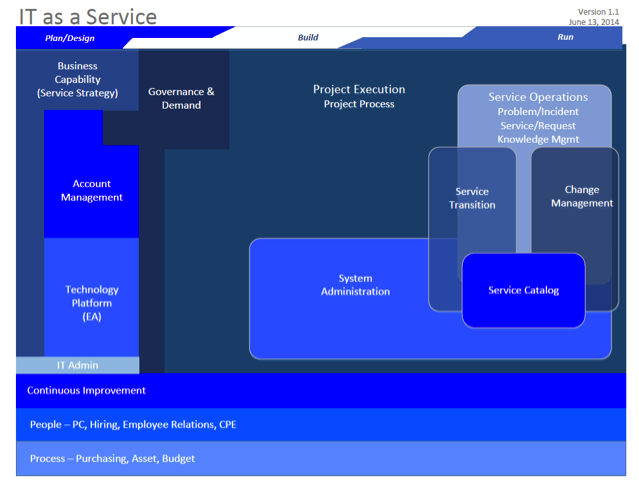
Think about how this maps to the services provided by an IT function. It’s really not that dissimilar, as I’ll review below. Let’s start by thinking about what we do in three major phases – design, build and run, as illustrated in our Wipfli ITaaS framework.
Designing Business Capabilities – “Design Phase”
Within information technology, there must be considerable work to understand the business plans and needs. Based on discussions with the various Wipfli industry, service line, niche, regional and specialty groups, there is a long list of needs, projects, upgrades and opportunities. This input shapes demand for improvements to current services; changes to existing tools, applications and systems; and completely new capabilities.
Through governance, budgeting, further analysis and some careful behind the scenes arm-twisting, a rolling list of “demand” is developed.
Building Infrastructure and Systems – “Build Phase”
The demand list drives project planning and resource allocation. Effective, agile project execution adds value through the enhancement, maintenance and/or addition of infrastructure and systems. We help provide business value by providing associates new capabilities. We enable the business, we don’t install technology – anyone can do that! A Dilbert comic that illustrates this point has stuck with me over the years.
There can also be “portfolios of projects” which are grouped together. For example, there could be several annual infrastructure upgrades that are group together for implementation. “Office Infrastructure Upgrades” could include switching, storage and server upgrades (the typical way we have approached these projects in the past).
Effective Service Delivery – “Run Phase”
Service delivery is where the customer’s experience is realized. The first and last impressions are created at the point of service delivery. Is it easy? Does it work consistently? When there is a problem is there an effective troubleshooting process?
Effective service delivery doesn’t happen by accident. The problem/incident process, transition from project to operations, change management and related processes need to be designed and constantly improved upon. The focus must be on the customers “moment of truth,” which happens each time they use their technology tools.
Obviously a critical and very visible part of service operations is the service desk or help desk. The problem/incident process is most effective with a quick diagnoses and remediation. With timely root cause analysis and deployment of a fix, there can be fewer incidents for each problem.
The best incidents are the ones that don’t happen.
Problem avoidance is driven through effective transition from project to operations: testing, documentation, training and communication. Change control also helps contribute to this problem avoidance. Effective management of assets, configuration data and service definition can also help avoid problems or make root cause and remediation efficient and effective.
Next time you’re dining out, try applying this design-build-run framework. What did you notice that contributed to an overall positive experience? What went on behind the scenes that contributed to the experience? How does that align with what you do in your daily work?
Learn more: Transformation to innovation. Changing the way IT and business get done.
 ZMAB15