Why Technology Still Needs the Human Touch
Posted: December 18, 2014 Filed under: Change, Technology | Tags: cognitive computing, IBM Watson, Marc Teerlink, Nicholas Carr Leave a commentLast week I had the privilege of attending the ITA 2014 Fall Collaborative in Washington D.C. This meeting was co-located with the Digital CPA Conference and we were privy to some great speakers. One of my favorites was Nicholas Carr, who has written extensively about the intersection of technology and human progress. A favorite breakout session was Marc Teerlink, the Chief Business Strategist for the IBM Watson project. Upon reflection, these two presentations were connected in more ways than I thought.
IBM Watson has moved from R&D to the commercialization phase. IBM is making a major investment ($1B) in this effort that uses cognitive computing to translate data into dollars.
Teerlink provided many examples where this is being applied by early adopters in healthcare, financial services and other areas that fit his framework of “observe, interpret, evaluate and decide.” Essentially, this refers to knowledge work and how to augment our ability to absorb the vast source of data that are available to us. He noted “we don’t have a data problem, we have a filter problem.” By this he meant that we so often feel overwhelmed by the volume and velocity of data that comes at us, but the real issue is that we don’t have a filter mechanism that tells us what is relevant for the situation.
Later, Carr shared his view of the new world of technology we live in. Essentially he stated that the cloud is our data center—a large central utility—much like the power plant of 100 years ago. Local computing (private data centers, local servers) is being displaced just like steam engines and local power plants were in their era. We are rapidly transitioning from the old infrastructure to the new. Our biggest challenge may be rethinking our business and anticipating what it is going to change. A key part of that is understanding where we add value and separating routine activities from innovative, unique and knowledge enhancing skills. One hurdle is integrating deep automation.
Now we’ve come full circle. Deep automation is based upon capabilities such as IBM Watson and highly sophisticated combination of technologies (cloud, mobile, big data, internet of things, social) that come together in ways we are just beginning to realize. For examples, look no further than driverless cars and 3D printing.
In Carr’s recent book The Glass Cage, he warns that there are unintended consequences of automation. At the most basic level, there are two categories:
- First, complacency. We become complacent because we trust technology to work flawlessly. We substitute the computer for our thinking.
- Secondly, accuracy. We believe anything presented to us through the pane of glass. Even though if it was on paper or spoken to us we might question it. The fact that it is from a computer and presented dispassionately, we believe it.
Here is a vivid example of the dual pitfalls of complacency and accuracy. A Seattle bus driver flawlessly executed the route presented to him by his GPS. He was complacent and didn’t give the route a thought. Even when presented with road signs indicating low bridge ahead, it didn’t register caution. The GPS (computer) presented the data and he proceeded despite additional signs, the GPS continued the route and his bus with 12’ clearance crashed into the 9’ clearance bridge. The accuracy of the GPS was absent an input (vehicle height) and constraint (bridge height). He trusted its accuracy implicitly and followed the bias that since it’s automated, it must be accurate.

Photo: Dan DeLong/Seattle Post-Intelligencer
Our challenge, then, is to focus our attention, stay alert and use these powerful tools to augment our abilities. As Marc Teerlink stated, “Computers don’t ‘predict.’ they present.” They present information and knowledge based upon rich sources of data. But they don’t have the intuition (tacit knowledge) that could be codified into a set of explicit rules. When we confuse this simple rule, we fall victim to complacency and an accuracy bias that is dangerous.
Our relationship with technology is far from perfect, but useful nonetheless. I much prefer the world where we can use sophisticated technology and allow the override by the highly trained professional when required.
Additional resources:
- By Nicholas Carr, All Can Be Lost: The Risk of Putting Our Knowledge in the Hands of Machines
-
Masters of our own destiny, Marc Teerlink’s Ted Talk on IBM Watson
Your Day is About to Change
Posted: November 4, 2014 Filed under: Change, Technology | Tags: CJ Bruno, Intel America, PDS Tech 2014 Leave a comment
CJ Bruno
Last week at PDS Tech 2014, I had the chance to hear and talk with CJ Bruno, VP and GM of Intel Americas. He offered a very interesting perspective on Intel hardware that’s in the pipeline. In short:
- Tiny motherboards taking up less space and consuming significantly less power.
- 3D cameras that will make password access to your devices so yesterday.
- An image of your head will become your password and PIN.
- Voice interface and wireless connections will facilitate device charging, video connections, file transfer and linking accessories. Convenient, yes, but more importantly, all about security.
But wait—this is the wrong end of the dog. The excitement around hardware and devices has given way to the age of the user experience. An easy to use, always on, always with you experience that integrates seamlessly throughout your day is on the horizon. These experiences, built on new cloud and mobile services, meet today’s lifestyle. No longer is computing done solely in your office and on your desktop. This concept goes beyond work/life balance—it’s integration. Our work organizations, work tools and work styles need to catch up to our lifestyles. When we think of something we want to act. Whether that is ordering an item from Amazon or following up on that task at work, you want it instantly and easily available to you regardless of where you are or what device you have nearby.
Intel’s Experience Vision video is a great depiction of what is possible. This is not futuristic—it will be enabled and available to consumers in less than two years.
I’ll close with a laugh for the day: Things IT People Never Say.
Boxes Old and New
Posted: September 25, 2014 Filed under: Change, Misc. | Tags: Crayola, Dropbox 1 Comment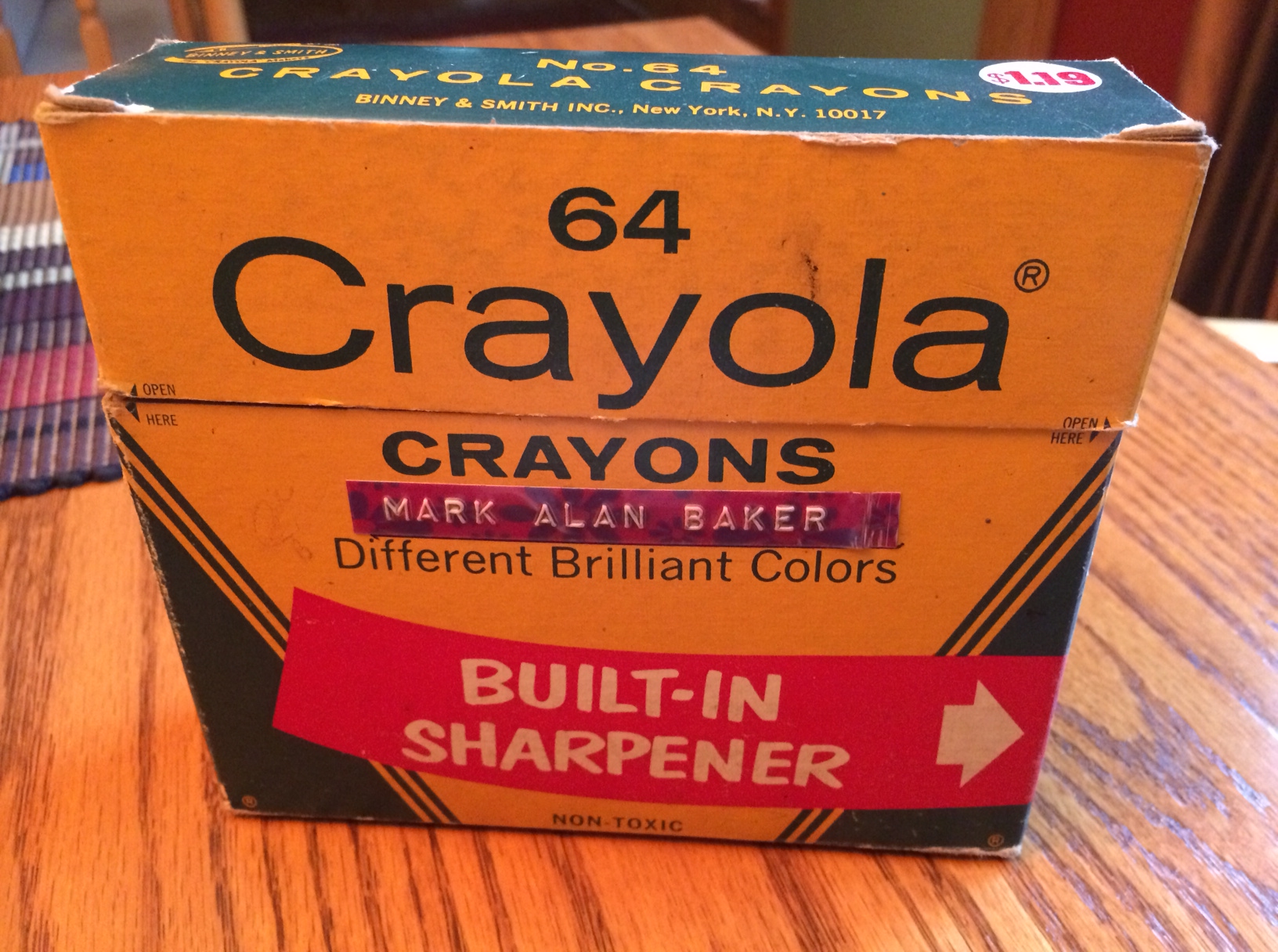
Photo by Mark Baker
For some strange reason (thanks Mom!) I still possess my grade school Crayola box. Back in the day, Crayolas were cool. What size box did you have? Did it have a sharpener? Another point of childhood pride was the school pencil box. Nestled in a flip-top homeroom desk, your pencil box was carefully labeled with your name and included the right pencils, a small ruler, safety scissors, an eraser and perhaps a protractor (the metal version with needle-sharp ends).
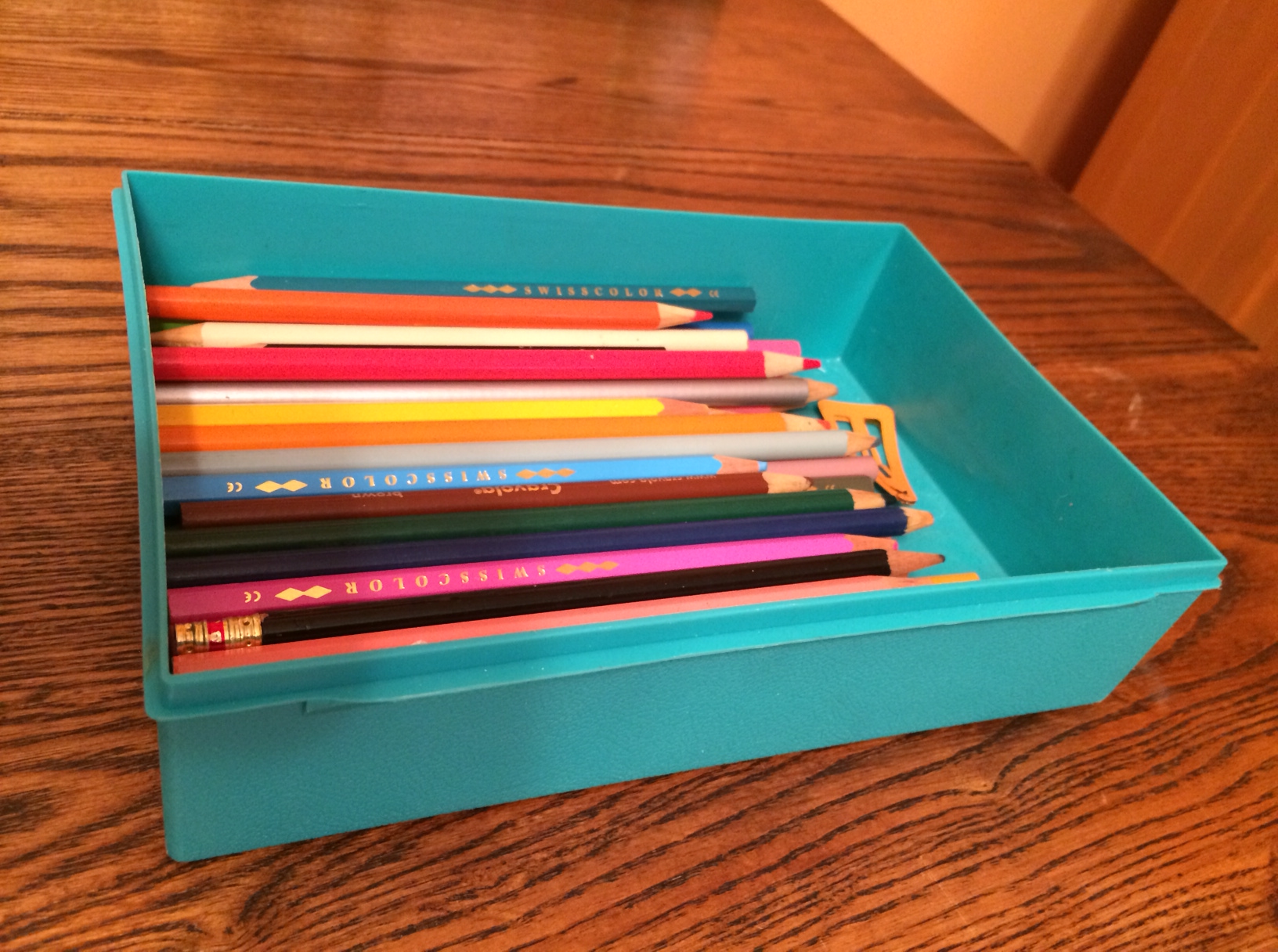
Photo by Mark Baker
Fast forward a bunch of years. As our daughters transitioned to far away places, we found pencil boxes left behind in their rooms (but no Crayola boxes). With all of the accoutrements required to outfit a college dorm or apartment these days, pencil boxes did not make the cut.
Instead, we set up Dropbox accounts with individual and shared folders. We loaded up key documents, synchronized photos across iOS devices, made images of official documents, and stored credit and identification card details. All of these resources can be accessed by any of us anywhere. Dropbox makes it easy and affordable: 1 Terabyte of storage is available for $100 per year under their pro plan. This is roughly twice my aggregated storage, which includes over 15,000 photographs and a decade worth of digital music and other files.
The irony of calling today’s robust, cloud-base resource a “box” is apparent. What a far cry from the humble little pencil box, but in today’s world, fills the same function. I’m not quite sure why this has me feeling a bit nostalgic. I don’t think it’s about the Crayola box per se, but more about the rapid evolution of technology, its ever-increasing role in our lives and how it shapes our interaction and communication. While my head understands that boxes hosted in the cloud hold unlimited capacity and potential, my heart misses the simple pleasure of opening a fresh box of crayons or neatly organizing my pencil box for the new school year.
 ZMAB15