From Vertical to Horizontal – Why?
Posted: October 8, 2014 Filed under: Business, Service, Technology | Tags: EMC, IT as a Service, ITaaS 2 CommentsThis is the first in a three-part series:
- From Vertical to Horizontal – Why?
- From Vertical to Horizontal – What?
- From Vertical to Horizontal – How? (coming soon)
The whole process of how to provide IT Services to an organization is going through a transformation. Much like technology cycles of the past (mainframe to distributed, PC revolution, Internet and cloud), IT departments and companies have also had to shift their work models. We’ve had shared services, outsourcing and now, the current shift to IT as a Service (ITaaS). EMC defines ITaaS as a:
…business centric approach which focuses on outcomes, operational efficiency, competitiveness, and rapid response. It optimizes the production and consumption of services consistent with business requirements.
Several elements come together to help drive the need for this change:
- Demand for IT solutions
- IT solutions need to be sustainable
- IT professionals need to shift their focus
Why? First, we have seen a dramatic increase in the demand for technology solutions. Recent consumer experience with technology has created heightened expectations for ease of use and mobility. New to the scene is the ability to leverage social tools in the enterprise to tap into knowledge and networks of expertise; engage associates in various professional and personal interests; and connect with customers and prospective customers in very different ways. Finally, the volumes of data that could unlock new understanding is just now starting to be tapped while there are large initiatives (network of things) that will provide exponentially more data.
IT groups are moving from focusing on providing infrastructure and large enterprise applications (systems of record) to helping drive new client services and products; new ways of collaborating across time, place, distance and organization; and rich methods of connecting with clients and prospects (systems of engagement).
IT personnel are expected to be able to provide and support more tools and software in an anytime, anyplace with anyone scenario. Traditional approaches are no longer able to meet these needs.
Second, IT solutions must be sustainable (meaning: able to be maintained). IT organizations have typically been largely reactive, focused on infrastructure and large enterprise applications. These have long provisioning cycles and long life cycles with plenty of maintenance in-between. A proactive stance— helping create a business outcome—is now expected. Solutions need to be simple and elegant, not inflexible and hard to learn. Approaches must be agile and not rigid. We must build solutions with building blocks and not make every unique solution to order. This second driver also requires a transformative shift.
Last, but most importantly, it’s about people. IT professionals are being asked to do a lot: provide excellent client service, deep technical expertise, solid routine operations and maintenance while communicating clearly in business terms. Concurrently we’ve moving from comfortable well-known solutions to cloud and multi-vendor solutions fraught with all of the pluses and minuses of “new.”
People are developing their skills, interacting with more internal and external parties, and putting together integrated solutions to provide business value. These are most often not generic, same-as-last-time approaches.
The solution involves moving to IT as a Service. This chart illustrates the model for ITaaS that we are beginning to employ at Wipfli.
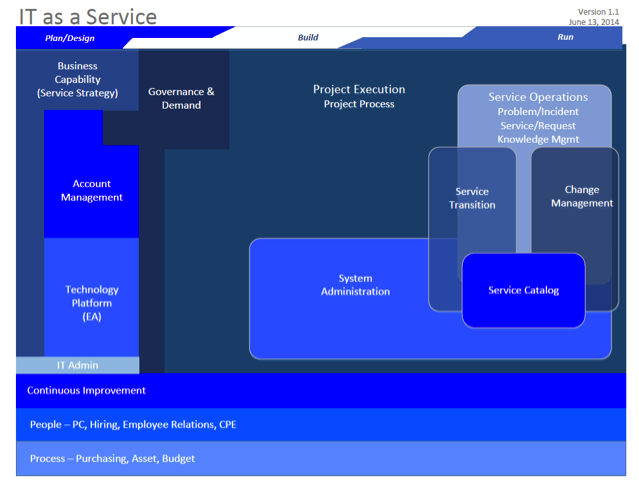
The paradigm shift involves transitioning from the primary focus being vertical silos of capabilities (infrastructure, network, applications, business analysis, project management and help desk) to a horizontal set of services broken down into three broad phases: design, build and run. Services are what is consumed; consider these examples:
- “Communications and collaboration” service includes email, phone, web meetings and instant messaging,
- “Workstation” service includes laptop, remote access, web access, office productivity applications and security components.
Information technology organizations must orient their operations to provide easy to consume, responsive and transparent services and not force consumers to feel like they are receiving a service produced by hand-offs between individual siloed departments.
Confessions of an iOS Fanboy
Posted: October 6, 2014 Filed under: Technology | Tags: Apple Pay, iOS8, iPhone 6, iPhone 6 Plus Leave a commentEarly last month, Apple had its annual September product announcement. I’m sure you’ve seen the headlines:
- IPhone 6 and iPhone 6 Plus are now available
- IPhone Watch is under construction for an early 2015 release
- iOS8 is standard on new devices and available as an upgrade for older models
These devices are larger and faster, with pricing pretty much staying the same. Yawn.
But wait—there’s more. A few features that were not prominently highlighted in the headlines are significant in my mind. These include:
- New HD retina displays that provides more contrast via a polarizer layer, creating a better user experience.
- Enhanced “under the hood” hardware.
- Near Field Communication antennae enables Apple Pay while opening the door to integrate payments into applications on the iOS platform.
- 3x faster WiFi (802.11ac), vitally important for video streaming and data sharing.
- A barometer, which measures atmospheric pressure and will provide elevation tracking and other uses over time.
- Updated camera—put that DSLR away. This will add to what I think is already a great tool.
- Image quality in low light, dynamic focusing and image stabilization.
- Video capture at 1080p and 120 fps.
- Front facing camera improvements for better and burst selfies (oh my!).
- User interface changes to support larger form factor “reachability.” This may put some of the concerns about one-handed use to rest.
- iOS 8 upgrades that provide better integration with the hardware and many additional enablers for developers.

Photo (and sketch) by Mark Baker
The biggest knock from the public on the new models is their increased size. In response, I would ask, “Are you really going to hold this up to your ear? If so, how often?” Today, thinking of an iPhone as primarily a phone is misguided. I’m sure I’m not alone in observing that as my usage of my iPhone has gone WAY UP, the voice minutes used have surely gone down—WAY DOWN.
Seven years ago when the original iPhone launched it was a phone first that added a mobile browser, music player and camera and a couple of other features. THAT WAS IT. The concept of an App Store didn’t even exist. Now, you practically have a complete computer desktop platform at your fingertips. The so-called iPhone has evolved to be an indispensible, highly portable, all-purpose digital communication device. That’s worth an upgrade.
R.I.P. iPod
Posted: September 22, 2014 Filed under: Technology | Tags: Apple, iPad, MP3 Leave a comment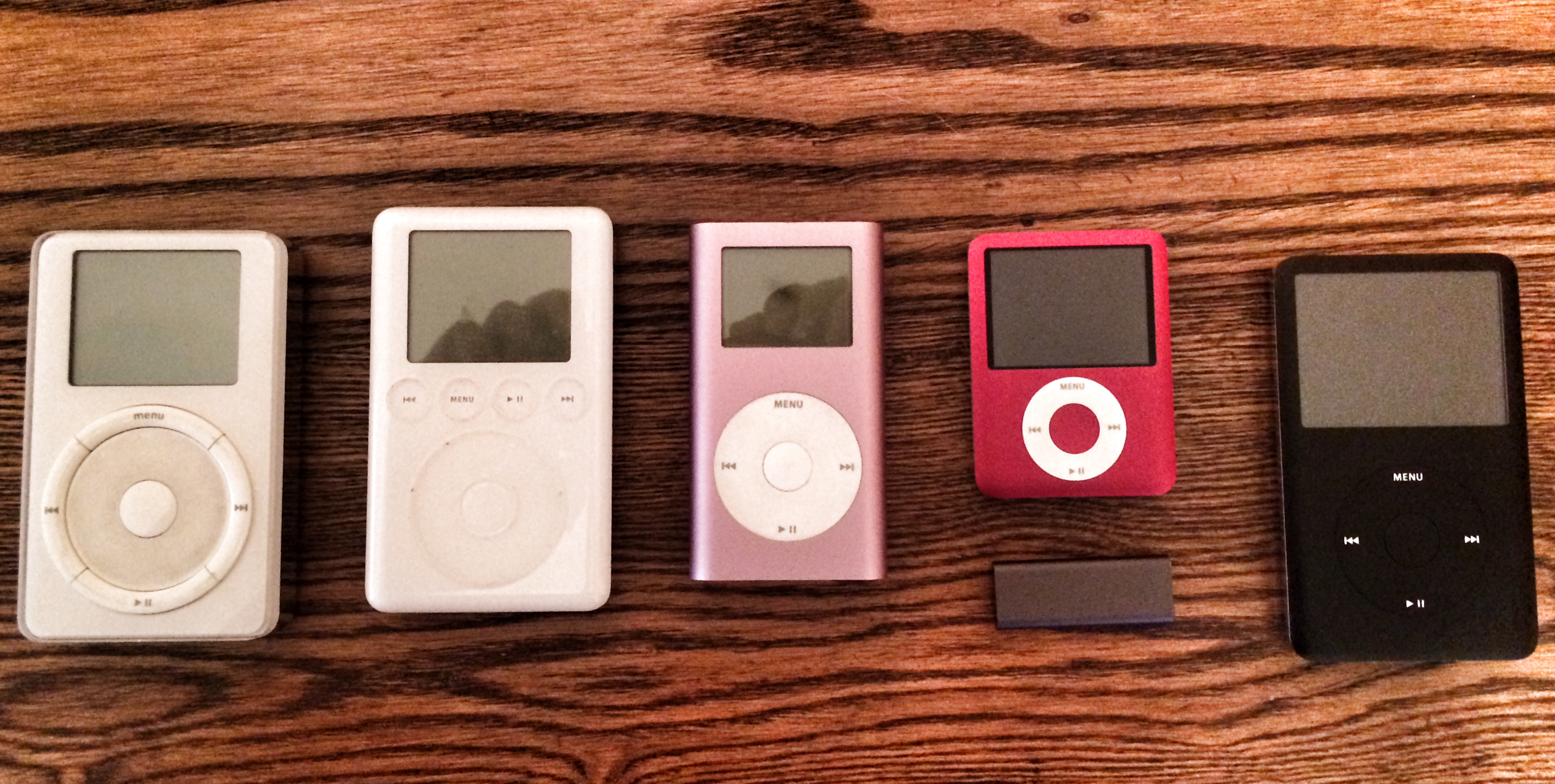
A veritable treasure trove of iPods collected at the Baker household. It’s quite possible there are a still a couple more hidden somewhere. Photo by Mark Baker.
First, the headline grabbed me: On Death and iPods: A Requiem. Then this well written article hooked me, its larger message a reflection on something I try to bring to the table every day. We often have surface conversations about the shiny new hardware (or in Apple’s case, the media fawning over the Apple announcements and the “just one more thing” shtick). However, focusing on the hardware often misses a crucial point. Hardware has features, but what we value are the benefits. The benefits are wrapped up in how we can do new things, how things become easier, or at the highest level, how we alter behavior in response to new capabilities.
The iPod fundamentally changed how we learn about, purchase, organize, share and consume music. Parents could no longer yell at their kids to turn the radio down. Kids didn’t have to share the stereo or tote around a massive boom box. Portable MP3 players drove the rapid expansion of new categories of accessories, such as docking stations, $400 stylized and branded headphones and Bluetooth speakers. And how can we forget the iconic white headphones?
In the end, like all technology, it’s not about the hardware. It’s about how it changes what we do. RIP iPod. You’ll be staying in my device museum to remind me of the good old days!
For more information on the history of the iPod and iTunes, this interesting timeline shows how far we’ve come.
 ZMAB15