Un-Unified Communication
Posted: April 22, 2015 Filed under: Business, Innovation, Technology | Tags: Asana, Bill Lumbergh, Cicso Spark, HipChat, Office Space, Quip, Slack, Verse 2 CommentsMy recent post demonstrated a difficult method to share notes. I want to contrast that experience with a very different one.
Several weeks ago, I connected with a regional sales leader for a national technology company that I’ve worked with. We spoke about how we are working differently and collaborating across companies in new and different ways. He was going to be attending an enterprise communications and collaboration conference the following week, and offered to share what he learned and subsequently get together to discuss.
To facilitate sharing, he launched a Cisco Spark collaboration room. My first reaction was a sarcastic groan, “Perfect, just what I need, another application.” But, in the spirit of embracing new approaches, I gave it a try.
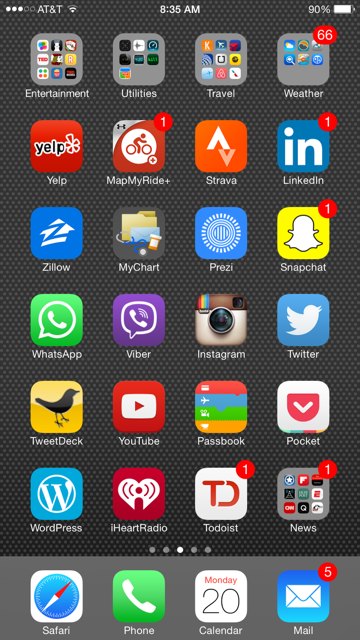
Photo by Mark Baker
Surprisingly, this proved to be an easy way to share content, links, and even coordinate our meeting over coffee. The reason why became clear when we spoke. While I, like many others, have always have a quest for “one”—one thing, one place, one neatly organized inbox or to-do list—I realized that the definition of “one” has shifted. Instead of using one application, the new standard is one mobile/tablet device filled with notifications. A speaker at the aforementioned conference labeled it “Un-Unified Communications.” Instead of one phone number, one voice mail system, and one email address, we now have multiple tools for communication and collaboration. Our inbox is a set of tiles with various notifications. Aha! This made total sense. While “fewer” may be easier to manage, the quest for “one” does not have to be the Holy Grail.
Beyond Spark, there are many other providers in this category, including Slack, Asana, Verse (coming soon from IBM), Quip, and HipChat. You may have seen the HipChat commercials during the NCAA basketball tournament, starring boss Bill Lumbergh from the classic business comedy, Office Space. These ads are so humorous because, unfortunately, they reflect the daily reality in a lot of companies. My fervent goal, as I test and try new ways to work and collaborate, is to avoid becoming a Lumbergh.
I use my smartphone for…
Posted: April 16, 2015 Filed under: Technology Leave a comment| Research | Entertainment | Payments | |
| Calendar | Shopping | Music | Identity |
| Texting | Scanning | Task list | Scanning |
| Camera | Weather | Reminders | Voice to text |
| Address book | News | Maps | GPS |
| Internet | Photos | Voice mail | Fitness tracking |
| Phone calls | Filing cabinet | Flashlight | Video calling |
| Social networking | Writing | Alarm clock | Games |
| Reading | Bookmarking | Travel management | Blogging |
That is more than what I do with a laptop computer. Less than eight years ago when the iPhone was launched, we thought it was a phone. Read this Asymco post about how this applies to the iWatch.
Life’s Too Short
Posted: April 13, 2015 Filed under: Change, Technology | Tags: service design 1 Comment


Portland has awesome street art and signage that complement the city’s reputation of being quirky, diverse, and progressive. This billboard caught my attention.

All photos by Mark Baker
The exploding world of mobile apps has set a new benchmark for how technology should work. In our daily lives, there is an app for every purpose: to check the weather, get sports scores, catch up on news, read a magazine, share updates with friends, book travel reservations, shop, or track workouts. One of my favorite examples is the Amazon mobile app with its ability to dynamically scan a product or barcode.
As apps have gotten increasingly easier to use and more refined, the same progression cannot be found in the traditional software that most businesses rely on. There is usually a distinct difference between applications written from the ground up after approximately 2008 and those written earlier. Earlier applications (think airline websites, like United) have lots of functionality on single screens, require training to use, and come from a “one size fits all” mindset. Even programs that have received a “face lift” can’t compare in terms of ease of use, personalization, and multi-functionality.
New approaches (Uber, an interface to a ride service, is a perfect example) are proliferating, but lots of traditional services can’t get from here to there. Unfortunately, I think we’re going to be stuck with the legacy of these systems for some time.
Life is too short to stick with outmoded technology when there is something new and better available. Consumers will continue to gravitate to the tools they find more accessible and efficient. In an upcoming post, I will address one of the fundamental toolsets that will help us get there: service design. This holistic approach focuses on the user experience when designing process, tools and service. Stay tuned.
 ZMAB15