Emotional Intelligence
Posted: May 13, 2015 Filed under: Leadership, Technology | Tags: emotional intelligence Leave a comment I’ve touched on the subject of emotional intelligence a couple of times in this blog (here and here), but it’s such a fascinating topic that it bears addition discussion. Why You Need Emotional Intelligence to Succeed includes excellent graphics that capture the highlights. A large part of being effective has to do with what you see in yourself and in interactions with others. If we believe this, how do we incorporate it into our daily and weekly practices?
We are so busy and constantly wired in, filling every little bit of time with interactions on our mobile devices, that sometimes person-to-person connections get the short shrift. Recently I did an experiment to test how invested I am in the relationship with my cell phone. I challenge you to do the same.
- Set the timer on your phone for 30 minutes.
- Do not touch your phone until the timer goes off.
What happened? Did you feel anxious (as I did) to not be in possession of your phone for more than a few minutes?
I love the productivity and convenience of mobile devices, and they are crucial to my work. However, I also think there is a balance. To be truly effective, we also need to be self-aware and socially aware. We need to make space (time and place) in our lives to think and to engage with others and the world around us. Let’s regain the ability to be away from our devices and not experience withdrawal symptoms. I’m working on it!
A Case for the iPad
Posted: May 1, 2015 Filed under: Technology 2 CommentsI’ll be the first to admit that this is a very specific view of the world. However, it is also a relevant one.
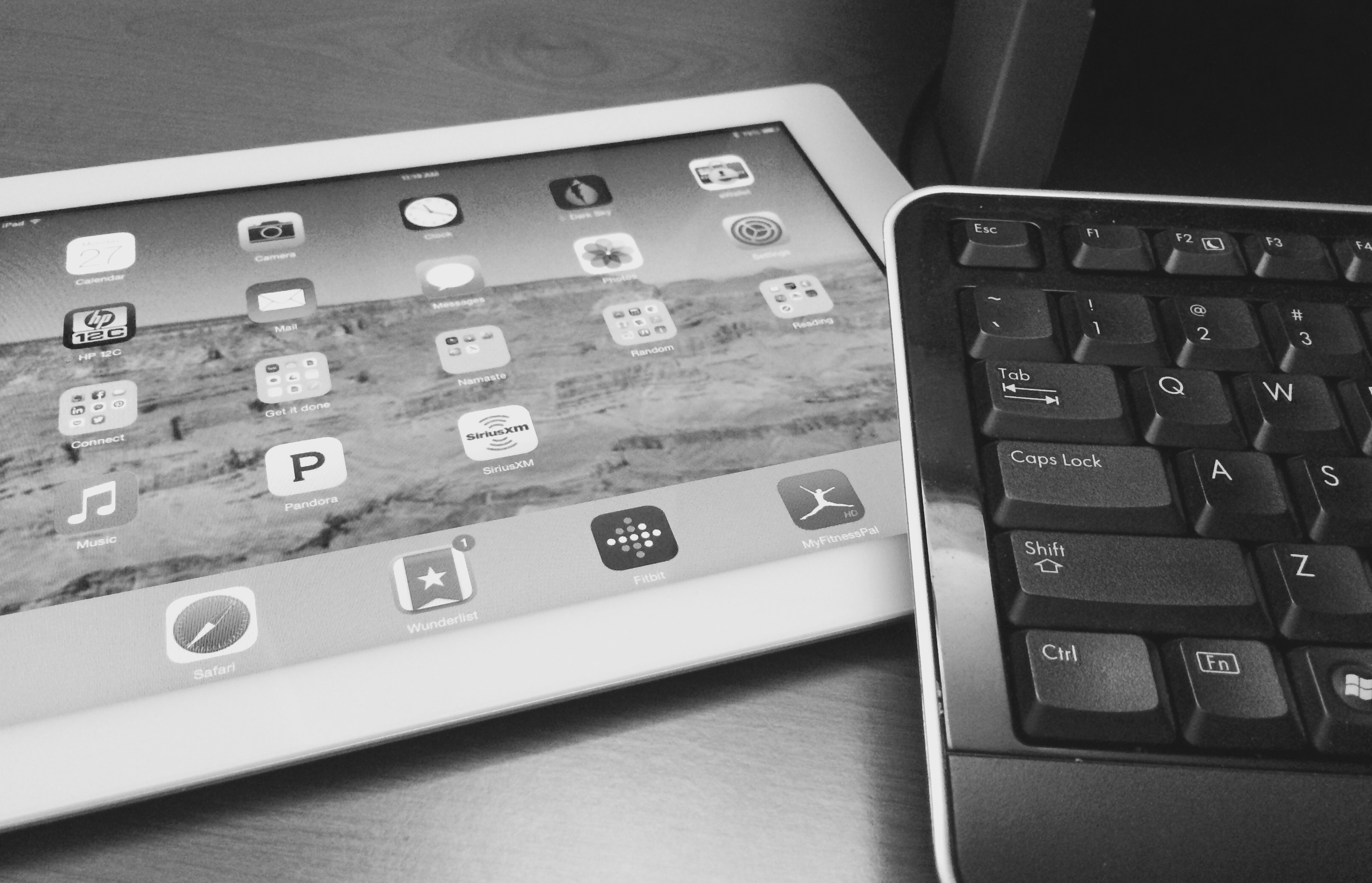 Last week I upgraded my mother to her third iPad, a hand-me-down iPad 4 to replace her much-used iPad 2. It was an incredibly smooth process: install current OS, restore backup from the cloud, and verify each application and password. It took roughly one hour beginning to end, with most of the time spent verifying passwords to avoid post-conversion support.
Noticeably, her fairly new Windows 7 computer had not been turned on in quite some time. There were security updates, Windows updates, and a virus scan pending. Mom asked me, “Do I still need that computer”? Good question. My answer was an equivocal, “Well, not really, but it’s not really hurting anything either.”
Upon further reflection, here’s my takeaway for someone like my mom. An iPad is more than sufficient for communication and light email. Updates are done with simple push of a button. New applications are acquired easily (and mostly for free). The most significant adjustment for a new user is the transition from the primary interface being a browser to using a multitude of applications. Hardware replacement is easy, and doesn’t involve a convulsive change. Remember Windows XP to Windows 7? This OS change drove massive hardware replacements, peripheral changes, and application suite changes. Agreeably, this may not be a fair comparison, but it makes the point.
At the end of the day, this iPad upgrade was enjoyable and left Mom with a big smile. What a different experience a few years (and change in platform) makes.
Interesting: notice the change in curve in the history of the person computer market graph over time. Windows 7 was released July 2009 and the Windows 7 SP1 in March 2010.
Weekly Download 15.7
Posted: April 27, 2015 Filed under: Weekly Download 1 Comment Here’s a recap of news and notes from around the Web that caught my attention over the past week or so.
Decisions vs. Choices: Is There a Distinction? Yes, and it is important. It helps us think about when we cut off alternatives (make a decision) vs. what are the choices we make. Are we clear so that important choices are made or considered before we make a decision? Seemingly, decisions are much easier once we have that clarity.
Read the letter Bill Gates sent to Microsoft employees for the company’s 40th anniversary. He takes a moment to reflect and celebrate, then sets the path for their future: “…what matters most now is what we do next.”
I’ve always been a fan of maps. For that matter, I appreciate just about any effective graphical display of information. Draftsman Henry Beck originally created the subway-style map in 1933 for the London Underground Tube. There is just one minor detail—it’s not really a map. Both Beck and the designer of the NYC subway version insisted that this style it be called a diagram (to represent the data, not be a geographical-based representation of all of the features). Semantics aside, 15 subway-style maps that explain everything but subways is intriguing and I think most of them work well.
If you are wondering how quickly disruptive business models can change things, read this. As of March 2015, Uber represents 47% of expensed rides processed by North America’s second largest expense reimbursement provider—up from 15% in March 2014.
 ZMAB15