Weekly Download 14.22
Posted: November 7, 2014 Filed under: Technology, Weekly Download | Tags: Chromebook, cloud, Core M Processor, design, Intel, iPad, MacBook Air, Marques Brownlee, windowless planes, Windows PC 2 Comments
Here’s a recap of news and notes from around the Web that caught my attention over the past week or so.
Cloudy With a Chance of Trouble. This perfect headline summarizes how employees are using a large variety of officially unsanctioned cloud-based tools in the workplace. The WSJ shows that regardless of the corporate approach, employees find creative ways to tap into these services.
Why Getting It Wrong Is the Future of Design. Just when design gets it right, some are headed to the wrong side, with often exciting results. I like the slightly deviant thinking reflected here that takes on the idea that perfect can be too perfect.
Don’t miss these tech reviews: great quality, great onscreen presence. This guy is a college senior, but already has six years of experience! Marques Brownlee, you’re a terrific example of what is possible in this new world.
Windowless planes could be here in 10 years—and they look amazing. Wow, this sure made me think.
In the evolving convergence of traditional devices and new devices, the long standing “how many devices” argument is still not clear. As soon as we think we’re close, there is yet another set of expectations to meet. Apple should make a better MacBook Air and not fret about the iPad looks at what may be on the horizon with hybrid devices. I love the toaster-meets-refrigerator imagery.
Intel Launches the Intel® Core™ M Processor, touted as the “optimal blend of mobility and performance.”
The Apple Mac Takes Its Place In The Post-PC World. The fight for market position is being won by Macs and Chromebooks, at the expense of Windows PCs.
Your Day is About to Change
Posted: November 4, 2014 Filed under: Change, Technology | Tags: CJ Bruno, Intel America, PDS Tech 2014 Leave a comment
CJ Bruno
Last week at PDS Tech 2014, I had the chance to hear and talk with CJ Bruno, VP and GM of Intel Americas. He offered a very interesting perspective on Intel hardware that’s in the pipeline. In short:
- Tiny motherboards taking up less space and consuming significantly less power.
- 3D cameras that will make password access to your devices so yesterday.
- An image of your head will become your password and PIN.
- Voice interface and wireless connections will facilitate device charging, video connections, file transfer and linking accessories. Convenient, yes, but more importantly, all about security.
But wait—this is the wrong end of the dog. The excitement around hardware and devices has given way to the age of the user experience. An easy to use, always on, always with you experience that integrates seamlessly throughout your day is on the horizon. These experiences, built on new cloud and mobile services, meet today’s lifestyle. No longer is computing done solely in your office and on your desktop. This concept goes beyond work/life balance—it’s integration. Our work organizations, work tools and work styles need to catch up to our lifestyles. When we think of something we want to act. Whether that is ordering an item from Amazon or following up on that task at work, you want it instantly and easily available to you regardless of where you are or what device you have nearby.
Intel’s Experience Vision video is a great depiction of what is possible. This is not futuristic—it will be enabled and available to consumers in less than two years.
I’ll close with a laugh for the day: Things IT People Never Say.
From Vertical to Horizontal – What?
Posted: October 28, 2014 Filed under: Business, Service, Technology | Tags: IT as a Service, ITaaS, touchpoints 3 CommentsThis is the second in a three-part series:
- From Vertical to Horizontal –Why?
- From Vertical to Horizontal –What?
- From Vertical to Horizontal –How? (coming soon)
The key to shifting to IT as a Service (ITaaS) is to orient your focus on the customer experience. Think of the example of going to a white tablecloth restaurant. What would a memorable dining experience feel like? What goes into providing an exceptional experience?
There are many touchpoints when the restaurant has an opportunity to create a favorable or unfavorable impression. They include the physical environment (parking, waiting area, bar, noise level, seating, lighting, view, etc.), everything related to the food (planning the menu, purchasing ingredients and preparation) and all matters staffing (hiring the right people, training and having the appropriate staffing level). All of the elements affect how you feel about the overall dining experience. Just because the food buyer found great tomatoes this week doesn’t ensure you’ll have a five-star Yelp rating experience.
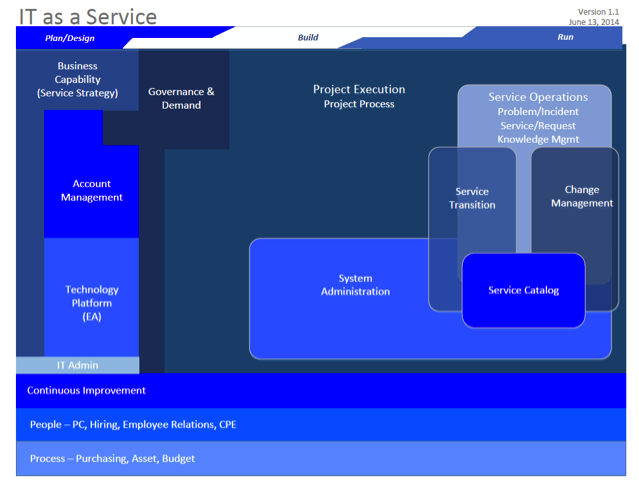
Think about how this maps to the services provided by an IT function. It’s really not that dissimilar, as I’ll review below. Let’s start by thinking about what we do in three major phases – design, build and run, as illustrated in our Wipfli ITaaS framework.
Designing Business Capabilities – “Design Phase”
Within information technology, there must be considerable work to understand the business plans and needs. Based on discussions with the various Wipfli industry, service line, niche, regional and specialty groups, there is a long list of needs, projects, upgrades and opportunities. This input shapes demand for improvements to current services; changes to existing tools, applications and systems; and completely new capabilities.
Through governance, budgeting, further analysis and some careful behind the scenes arm-twisting, a rolling list of “demand” is developed.
Building Infrastructure and Systems – “Build Phase”
The demand list drives project planning and resource allocation. Effective, agile project execution adds value through the enhancement, maintenance and/or addition of infrastructure and systems. We help provide business value by providing associates new capabilities. We enable the business, we don’t install technology – anyone can do that! A Dilbert comic that illustrates this point has stuck with me over the years.
There can also be “portfolios of projects” which are grouped together. For example, there could be several annual infrastructure upgrades that are group together for implementation. “Office Infrastructure Upgrades” could include switching, storage and server upgrades (the typical way we have approached these projects in the past).
Effective Service Delivery – “Run Phase”
Service delivery is where the customer’s experience is realized. The first and last impressions are created at the point of service delivery. Is it easy? Does it work consistently? When there is a problem is there an effective troubleshooting process?
Effective service delivery doesn’t happen by accident. The problem/incident process, transition from project to operations, change management and related processes need to be designed and constantly improved upon. The focus must be on the customers “moment of truth,” which happens each time they use their technology tools.
Obviously a critical and very visible part of service operations is the service desk or help desk. The problem/incident process is most effective with a quick diagnoses and remediation. With timely root cause analysis and deployment of a fix, there can be fewer incidents for each problem.
The best incidents are the ones that don’t happen.
Problem avoidance is driven through effective transition from project to operations: testing, documentation, training and communication. Change control also helps contribute to this problem avoidance. Effective management of assets, configuration data and service definition can also help avoid problems or make root cause and remediation efficient and effective.
Next time you’re dining out, try applying this design-build-run framework. What did you notice that contributed to an overall positive experience? What went on behind the scenes that contributed to the experience? How does that align with what you do in your daily work?
Learn more: Transformation to innovation. Changing the way IT and business get done.
 ZMAB15